
Jun 09, 2026 · 19 min read
Business Automation Trends to Watch for 2026
Explore business automation trends in 2026, from enterprise automation and BPA to AI agents, process mining, IDP, and low-code tools.
Services
Our service offers a team of engineers, designers, and QA specialists to achieve your goals.
See how it worksYou gain a team of experts including engineers, designers, and QA who drive your project.
See what our Dev team can build for you
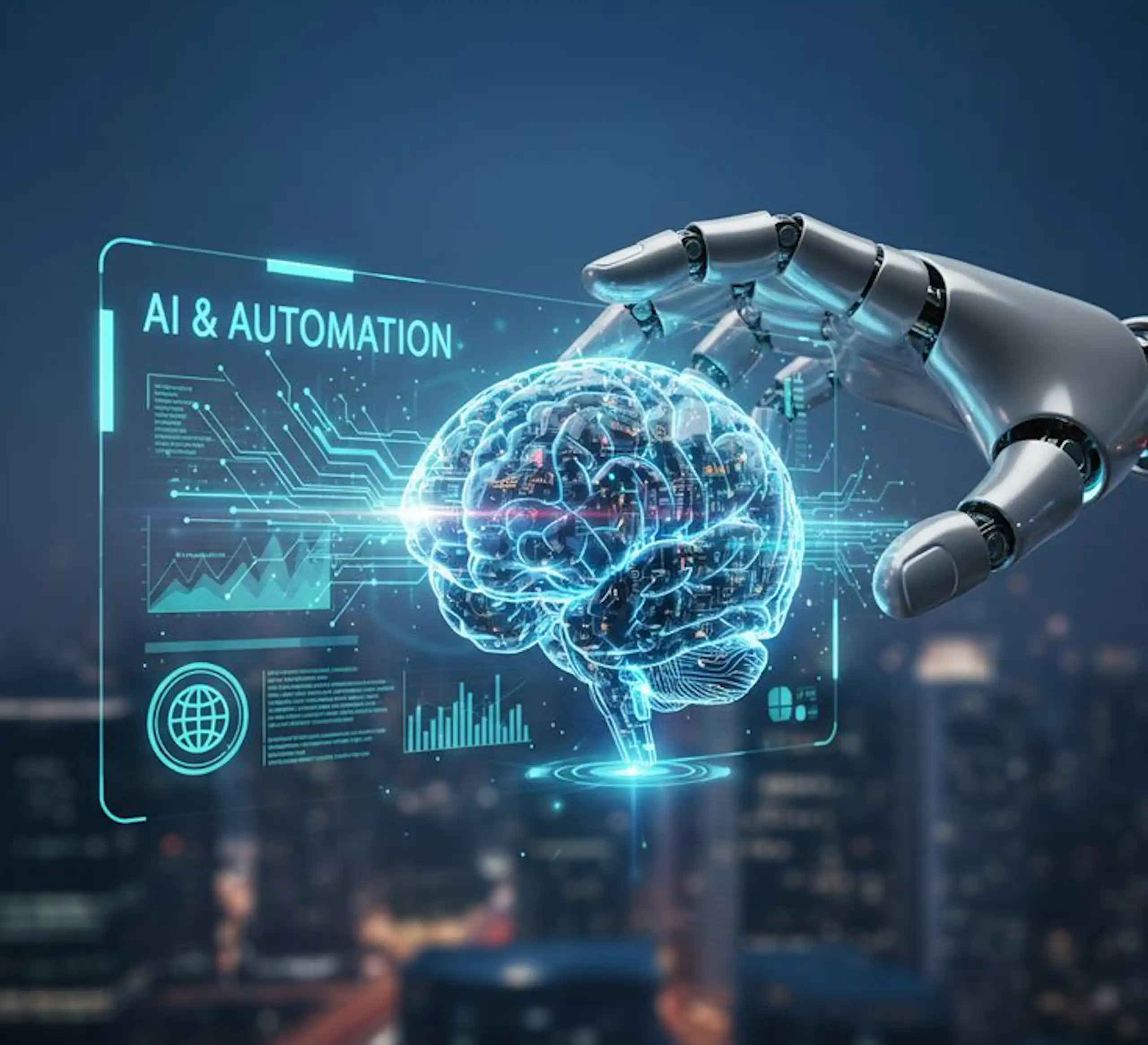
Most businesses do not have an AI automation problem in 2026. They have a workflow problem.
They bought new automation tools, tested a few copilots, added an automation platform, and maybe even paid for premium AI software. But the real work still moves too slowly. Teams still chase approvals in Slack, re-enter data across systems, wait on manual reporting, and lose hours to repetitive admin. The result is familiar: more tools, more noise, and not enough measurable business value.
That is why the biggest shift in AI and automation this year is not about hype. It is about execution. The winners are no longer asking, “How do we try AI?” They are asking, “Where can we remove friction, improve decisions, and automate the process without creating new risk?” McKinsey reports that 88% of organizations now use AI in at least one business function, yet only about one-third have started scaling it across the enterprise. In other words, adoption is rising much faster than impact.
If you only read one section of this guide, read this one. The biggest AI automation trends in 2026 are clear: businesses are moving from AI copilots to AI workflow automation, using smaller and cheaper AI models, focusing on production instead of pilots, and building governance into every automated system from the start.
1. AI is moving from copilots to workflow ownership
In 2026, AI and automation are no longer limited to helping with isolated tasks. More businesses now use AI to read information, make decisions, route work, and trigger actions across systems. The shift is from assistance to AI workflow automation that helps run entire processes with human oversight.
2. Process redesign comes before scaling AI
The smartest companies do not layer AI on top of broken workflows. They first improve the way work moves, then apply **process automation** where it can create speed, consistency, and better outcomes. If the process is messy, adding AI usually makes the mess move faster.
3. Smaller and cheaper AI models are expanding practical use cases
Better and more affordable AI models are making automation more accessible for startups and lean teams. Businesses can now use AI software for lead qualification, proposal drafting, document handling, reporting, and other focused use cases without needing enterprise-sized budgets.
4. Production matters more than pilots
Many businesses have tested AI. Far fewer have turned those tests into working systems. In 2026, the real advantage comes from moving beyond experiments and using automation tools to solve one high-friction business problem at a time.
5. Governance is now part of modern automation
As AI technologies take on more business tasks, companies need more than speed. They need control. Human review, access rules, audit trails, and clear boundaries are now a core part of any trusted automation platform, not something added later.
6. The strongest AI systems are quiet, practical, and operational
The future of ai and business is not just flashy demos or chatbot features. It is embedded systems that reduce delays, remove repetitive work, and help teams automate the process behind the scenes. This is where real digital transformation happens.
7. ROI is the metric that separates real progress from hype
In 2026, owning more tools is not the goal. The real value of process and automation is measured by faster cycle times, fewer errors, better conversion, stronger margins, and the ability to scale AI in ways that support business growth.
Bottom line: The companies pulling ahead in 2026 are not just adopting AI and automation. They are applying it to the right workflows, keeping humans in control, and building systems that deliver measurable results.
The AI automation market in 2026 is growing fast, but demand is no longer spread evenly. Buyers are spending where the pain is obvious and the return is measurable: customer support, sales operations, finance workflows, reporting, document processing, and service delivery. In simple terms, the strongest AI automation services demand in 2026 is concentrated in workflows that are repetitive, slow, expensive, and hard to scale manually.
At the same time, the business model is changing. AI automation business models in 2026 are moving beyond fixed retainers and per-seat software pricing. More providers are shifting toward usage-based pricing, outcome-based pricing, and what many buyers now see as agent-as-a-service. Instead of paying only for access to a tool, companies increasingly want to pay for a result: a resolved support request, a completed workflow, a qualified lead, or a processed document. That shift reflects a more mature market. Buyers are less interested in generic AI access and more interested in business outcomes.
So, is the AI automation market saturated in 2026? Not exactly. The noisy part of it is. There are more AI agencies, more automation offers, and more lookalike services than ever. But the real market is not saturated. It is becoming more selective. Companies are no longer impressed by vague promises or disconnected pilots. They want partners who can improve a real workflow, integrate with existing systems, reduce risk, and show measurable ROI.
That is the real story in 2026. The opportunity is still strong, but the bar is higher. Demand is growing for practical, workflow-led delivery. What is fading is undifferentiated AI hype.
Bottom line: the market is not too crowded for credible AI automation firms. It is too crowded for firms that cannot tie automation to a clear business result.
The biggest mistake in AI automation right now is talking about the market as if every company needs the same thing. They do not. In 2026, enterprise AI automation trends are mostly about scaling across departments without losing control. For smaller companies, the focus is different: affordable AI agents, faster setup, and one clear workflow win at a time. Deloitte’s 2026 reporting shows enterprise adoption is moving from pilots toward production, while U.S. Census data continues to show larger firms leading on AI use by size. At the same time, the small-business gap is narrowing, and platforms like Meta are pushing low-friction business agents into mainstream SMB workflows.
At a practical level, the difference looks like this:
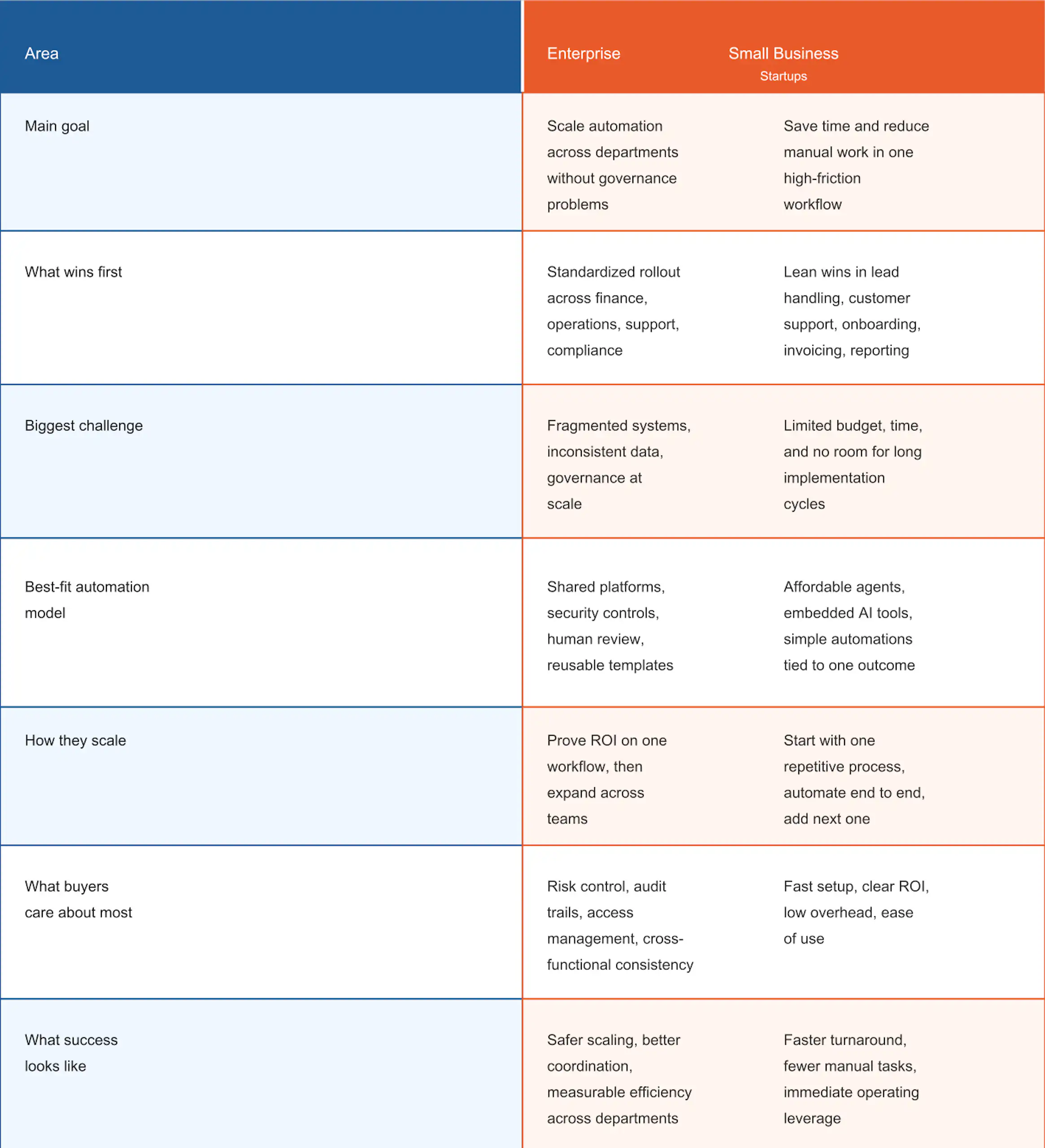
That table reflects the real divide in the market. Enterprises are asking how to scale automation across departments with strong governance, clear data foundations, and repeatable operating models. McKinsey and OpenAI both point to the same bottleneck: the hard part is no longer access to models, but organizational readiness, workflow redesign, and reliable deployment at scale. Small businesses, by contrast, are adopting AI where it is affordable and easy to apply. The strongest early wins are usually narrow, operational, and measurable.
Enterprise AI automation in 2026 is about governed scale. Small-business AI automation is about practical speed. Both matter, but they solve different problems and require different delivery models.
For a deeper look, see our guide to business and enterprise automation trends in 2026.
A lot of companies still treat AI automation as a layer they can place on top of outdated operations. That rarely works.
If a process is unclear, full of exceptions, and split across disconnected systems, adding AI usually makes the mess faster, not better. Deloitte’s 2026 research makes the same point: organizations that win are not layering AI onto broken processes. They are rebuilding work around focused, measurable outcomes.
This matters for startups and professional services firms especially. When margins depend on speed, quality, and client trust, every manual hand-off becomes expensive. Slow proposals, delayed onboarding, scattered project data, and inconsistent follow-up all create hidden drag. These are not just operational headaches. They are growth constraints.
Doing nothing used to feel safe. In 2026, it is expensive.
First, manual work is compounding. Microsoft’s 2025 Work Trend Index found a growing capacity gap: 53% of leaders said productivity must increase, while 80% of workers and leaders said they lack enough time or energy to do their jobs well. The report also found that employees are interrupted every two minutes on average during the workday.
Second, the market is moving. Stanford’s 2025 AI Index found that business AI adoption rose from 55% in 2023 to 78% in 2024, while use of generative AI in at least one business function jumped from 33% to 71%.
Third, the economics are changing fast. Stanford also found that the cost of using capable ai models has dropped dramatically. A model performing around GPT-3.5 level fell from $20 per million tokens in late 2022 to $0.07 by October 2024, with inference prices falling anywhere from 9 to 900 times per year depending on the task. Smaller models are improving too, which means companies can deploy faster, cheaper, more targeted systems.
That changes the equation for AI and business. Waiting is no longer just a technology delay. It is a competitive delay.
.jpg_2pd0bq?tr=w-2560,f-webp,q-50)
Here are the AI and Automation Trends in 2026 that business decision makers should pay attention to:
1. The conversation has moved from copilots to workflow ownership
In 2025, many teams used AI as an assistant. In 2026, the serious shift is toward AI handling parts of full workflows.
Microsoft describes this as a move from assistants to “digital colleagues,” and eventually to agents that can run entire business processes with human oversight. Nearly half of leaders in its study said their companies are already using agents to fully automate workflows or processes.
That means process automation is no longer just about rules-based bots. It now includes AI systems that can read, reason, route, draft, classify, summarize, and trigger actions across tools.
2. The best companies redesign work before they scale AI
We found that workflow redesign is one of the strongest factors linked to meaningful AI impact. High performers are far more likely to redesign workflows, define when humans should validate model outputs, and embed AI into business processes with clear KPIs.
That is the difference between “using AI” and knowing how to scale AI.
If your team only adds chat interfaces and content generation, you may get small productivity gains. If you redesign intake, approvals, client delivery, reporting, and knowledge management around process and automation, you create operating leverage.
3. Smaller, cheaper AI is expanding the practical use cases
This is one of the most important 2026 changes for real-world delivery. As smaller AI models get better and usage costs drop, more companies can build targeted internal systems without betting everything on one giant model or one expensive vendor.
That opens up practical use cases such as:
For many firms, the next wave of AI technologies will not be flashy. It will be embedded, quiet, and operational.
4. Pilot fatigue is real, and production is still hard
The market is full of experiments. Production success is still rare.
Deloitte found that only 25% of respondents had moved 40% or more of their AI pilots into production, and only 30% said they were redesigning key processes around AI. Another 37% reported using AI only at a surface level with little or no change to underlying business processes.
This is the warning sign for any company chasing disconnected proofs of concept. You do not need more pilots. You need a delivery plan tied to one business outcome.
.jpg_uWJUNt?tr=w-2560,f-webp,q-50)
5. Governance is becoming part of the product, not a side document
As automation grows more autonomous, governance matters more. We found that 51% of respondents at organizations using AI reported at least one negative consequence from AI use, with nearly one-third citing issues related to inaccuracy. Deloitte adds that while close to three-quarters of companies plan to deploy agentic AI within two years, only 21% report having a mature model for agent governance.
So in 2026, trusted delivery means more than good prompts. It means human review paths, access controls, audit trails, model selection rules, fallback logic, and clear boundaries for what AI should and should not do.
Not every problem needs AI. Not every process should be automated.
Automation is the right fix when five conditions are true:
The work is repeated often
If your team does the same steps every day or every week, there is a strong case for process automation.
The process does not follow a clear path
Good candidates have defined inputs, repeatable decisions, and predictable outputs. This is where automation tools and AI-assisted logic work best.
The team is losing time, not judgement
Use AI where people are buried in admin, not where they add unique strategic value. The goal is not to replace expertise. It is to protect it.
The data is not available
Strong AI software depends on usable data, connected systems, and a realistic delivery architecture. If your information is trapped in inboxes and spreadsheets, fix that first.
Success can't be measured
The best projects tie directly to cycle time, error reduction, utilization, conversion rate, margin, or customer response time. If you cannot measure it, you probably should not automate it yet.
For startups and service businesses, the most valuable starting point is usually not a broad digital transformation program. It is one high-friction workflow with clear ROI. Think client onboarding, internal approvals, sales operations, reporting, billing, or service delivery coordination.
The companies getting results are doing a few simple things well.
They are picking a narrow, high-value process. They are choosing the right mix of AI automation, rules, and human review. They are using the right automation platform for integration, visibility, and control. And they are building around measurable business outcomes, not abstract innovation language. That is how they move from experimentation to scale.
Most of all, they understand that AI and automation is not a software shopping exercise. It is an operating model decision.
1. What are the key AI automation trends in 2026?
The biggest AI automation trends in 2026 are the shift from AI copilots to AI that owns full workflows, the rise of smaller and cheaper AI models, stronger focus on moving pilots into production, and governance becoming part of the system from day one. The real difference in 2026 is not who is trying AI, but who is applying it to the right workflows and getting measurable results.
2. What is the future of AI automation?
The future of AI automation is moving from assistants that support tasks to agents that run multi-step processes under human oversight. As AI models become more affordable and capable, more businesses will use AI to handle operational work such as routing, classification, approvals, reporting, and follow-up. The long-term advantage will come from redesigning work around outcomes, not from owning more tools.
3. Is demand for AI automation services growing in 2026?
Yes, demand for AI automation services in 2026 is growing, but the market is becoming more practical. Businesses are moving past experimentation and looking for help with workflow redesign, system integration, governance, and production rollout. Demand for “help us try AI” is slowing down, while demand for “help us automate a real business process with clear ROI” is growing fast.
4. Is the AI automation market saturated in 2026?
The AI automation market in 2026 is crowded, but it is not saturated where it matters most. There are many vendors, tools, and generic offers, but far fewer firms can turn AI into a working, governed, high-value workflow. Saturation is happening in software and hype, not in delivered outcomes. That leaves strong room for businesses that can solve real operational problems.
5. What new business models is AI automation creating in 2026?
The main AI automation business models in 2026 are shifting from software access to business outcomes. That includes usage-based pricing, outcome-based contracts, and agent-as-a-service models where companies pay for completed tasks, resolved requests, or processed workflows instead of just paying per seat. Buyers increasingly want automation tied to measurable results, not just another subscription.
6. How do you decide which processes to automate with AI?
You should automate a process with AI when it is repeated often, follows a predictable path, depends on available data, consumes time more than judgment, and has a clear success metric. The best AI automation use cases in 2026 are usually high-friction workflows like onboarding, approvals, reporting, lead handling, document processing, and support operations. If the outcome cannot be measured, the process usually is not ready for AI automation yet.
The big story in 2026 is not whether AI is real. That debate is over.
The real question is whether your business knows how to turn better AI technologies into better workflows, faster delivery, and stronger margins. The companies that will win are not the ones with the most demos. They are the ones that know where to apply AI, where to keep humans in control, and how to build systems that create repeatable value.
Ready to move from AI experiments to real business impact?
At Wazobia Technologies, we help startups and professional services firms design and deliver practical AI and automation systems that improve operations, reduce manual work, and create measurable results. Schedule a free consultation to identify the right workflow, choose the right architecture, and build with confidence.
Frequently asked questions
The biggest AI automation trends in 2026 are the shift from AI copilots to AI that owns full workflows, the rise of smaller and cheaper AI models, stronger focus on moving pilots into production, and governance becoming part of the system from day one. The real difference in 2026 is not who is trying AI, but who is applying it to the right workflows and getting measurable results.
The future of AI automation is moving from assistants that support tasks to agents that run multi-step processes under human oversight. As AI models become more affordable and capable, more businesses will use AI to handle operational work such as routing, classification, approvals, reporting, and follow-up. The long-term advantage will come from redesigning work around outcomes, not from owning more tools.
Yes, demand for AI automation services in 2026 is growing, but the market is becoming more practical. Businesses are moving past experimentation and looking for help with workflow redesign, system integration, governance, and production rollout. Demand for help with trying AI is slowing down, while demand for help with automating a real business process with clear ROI is growing fast.
The AI automation market in 2026 is crowded, but it is not saturated where it matters most. There are many vendors, tools, and generic offers, but far fewer firms can turn AI into a working, governed, high-value workflow. Saturation is happening in software and hype, not in delivered outcomes. That leaves strong room for businesses that can solve real operational problems.
The main AI automation business models in 2026 are shifting from software access to business outcomes. That includes usage-based pricing, outcome-based contracts, and agent-as-a-service models where companies pay for completed tasks, resolved requests, or processed workflows instead of paying per seat. Buyers increasingly want automation tied to measurable results, not just another subscription.
You should automate a process with AI when it is repeated often, follows a predictable path, depends on available data, consumes time more than judgment, and has a clear success metric. The best AI automation use cases in 2026 are usually high-friction workflows like onboarding, approvals, reporting, lead handling, document processing, and support operations. If the outcome cannot be measured, the process usually is not ready for AI automation yet.
Keep Reading
Jun 09, 2026 · 19 min read
Explore business automation trends in 2026, from enterprise automation and BPA to AI agents, process mining, IDP, and low-code tools.
Jun 05, 2026 · 13 min read
Learn how to write effective AI prompts. Master specificity, clarity & structure to get better results. Expert guide with practical tips.

May 25, 2026 · 8 min read
Learn how to reduce software development cost with AI integration through smarter workflows, automation, and practical support
© Wazobia Technologies 2026

