
Jul 23, 2026 · 8 min read
Database vs Spreadsheet: When Should a Business Upgrade?
Compare a database vs spreadsheet for managing business data. Learn the signs that spreadsheets are limiting your workflow and what to use instead.
Services
Our service offers a team of engineers, designers, and QA specialists to achieve your goals.
See how it worksYou gain a team of experts including engineers, designers, and QA who drive your project.
See what our Dev team can build for you
.jpg_qVhL84?tr=w-2560,f-webp,q-50)
A service marketplace is an online platform that connects customers with independent professionals or businesses that provide services. It lets users discover, compare, book and pay providers, while supporting profiles, scheduling, messaging, reviews and marketplace commissions. Examples include Upwork, TaskRabbit and Angi.
These platforms usually serve three groups: customers looking for services, providers offering them, and the marketplace operator managing the transaction. Their core value is making it easier for customers to find trusted providers and for providers to access new demand.
The platform usually has three main user groups:
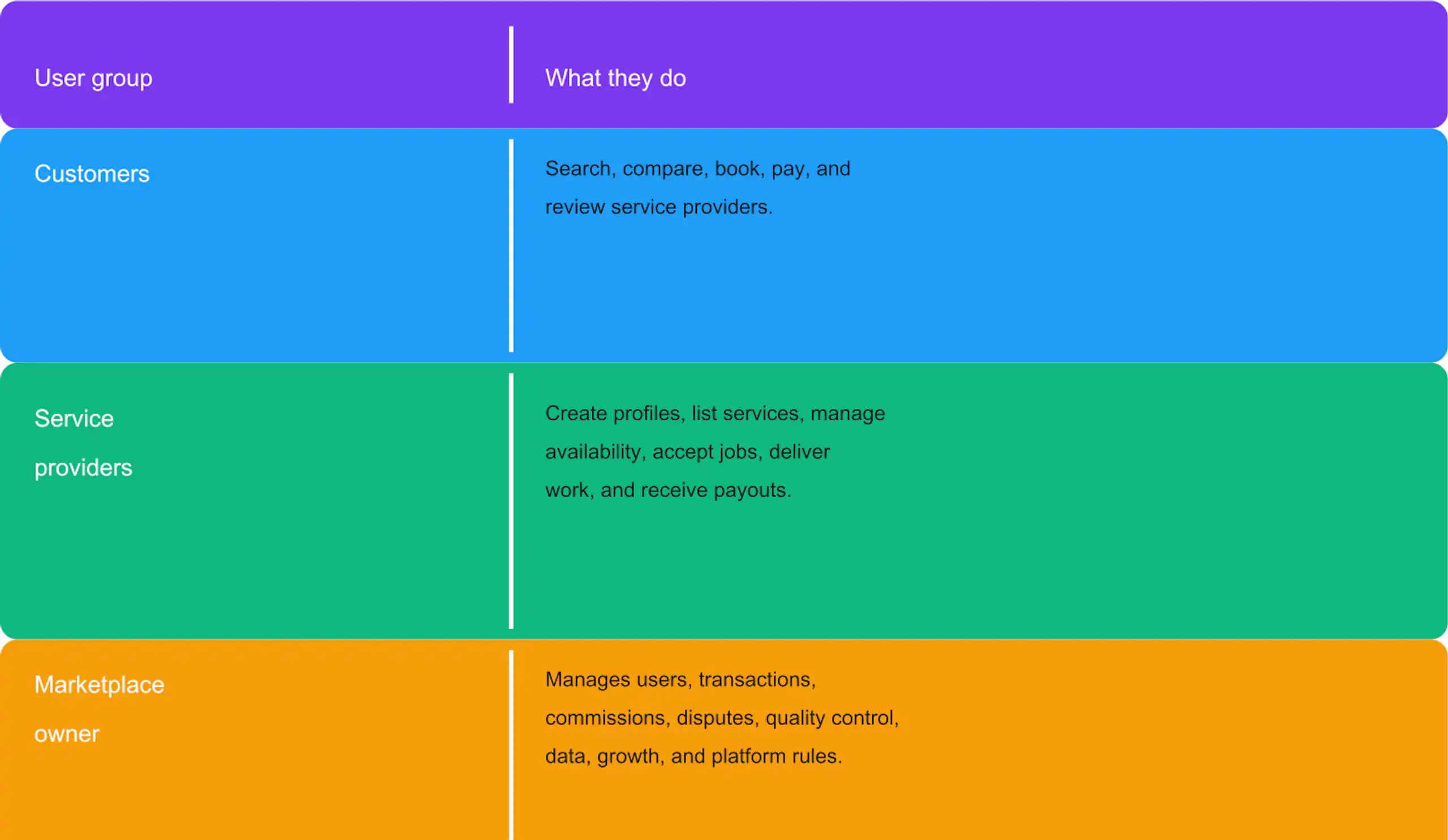
For example, a homeowner may need a plumber, an SME may need a freelance designer, or a company may need a vetted software engineer. Instead of manually searching, calling, comparing, and negotiating with multiple providers, the customer uses one platform to find the right option and complete the transaction.
That convenience is the core value of a service marketplace.
The marketplace makes money by reducing friction between supply and demand. It helps customers find trusted providers faster, helps providers access more demand, and gives the platform owner a monetizable transaction layer.
Most service marketplaces follow a similar flow, even when they operate in different industries.
Service providers sign up, create a profile, and submit details such as skills, service categories, pricing, availability, location, portfolio, certifications, or business documents.
For higher-trust categories like healthcare, financial services, home repairs, childcare, or professional consulting, the platform may also include identity checks, license verification, insurance checks, background screening, or manual approval.
Providers create listings that explain what they offer, what is included, how much it costs, where the service is available, and when they can deliver it.
A strong listing usually includes pricing, service scope, images, FAQs, reviews, response time, cancellation rules, and clear expectations.
Customers search for a service and narrow results by location, price, rating, availability, service category, provider type, delivery method, or urgency.
In more advanced marketplaces, matching can be algorithmic. The system can recommend providers based on proximity, past performance, availability, job complexity, response rate, or customer preferences.
Some services are simple enough for instant booking. Cleaning, beauty services, tutoring sessions, and consultations may use fixed time slots and fixed pricing.
Other services need custom quotes. Plumbing, renovation, legal work, B2B services, or software projects often require the customer to describe the job, upload details, and receive proposals before booking.
The marketplace collects payment from the customer, deducts a commission or service fee, and pays the provider after the service is completed or approved.
Payment infrastructure is one of the most important parts of marketplace development. Tools like Stripe Connect are built specifically for platforms and marketplaces, supporting onboarding, embedded payments, global payouts, compliance tooling, and multi-party money movement.
The provider delivers the service online, in person, or at the customer’s location. During this stage, the platform may support messaging, file sharing, live tracking, reminders, rescheduling, milestones, or job status updates.
After completion, customers can review the provider. Reviews help future customers make decisions and give the marketplace a trust layer.
If something goes wrong, the platform needs rules for refunds, cancellations, disputes, no-shows, poor delivery, fraud, and provider removal.
Once the transaction is complete, the provider receives their payout. The platform owner tracks commissions, revenue, customer acquisition, booking volume, provider performance, retention, dispute rates, and other marketplace health metrics.
A product marketplace and a service marketplace may look similar on the surface, but they behave differently in practice.
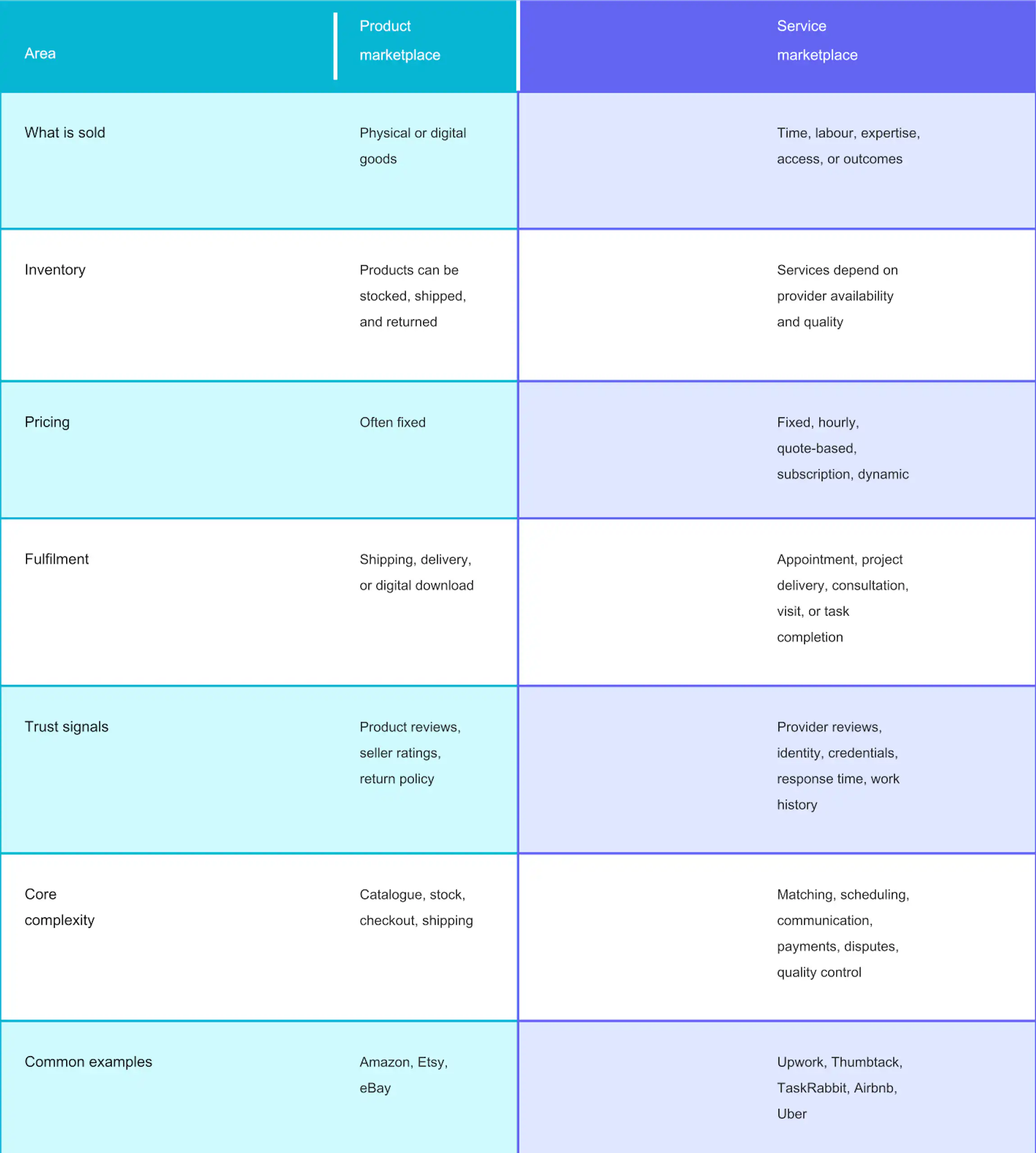
This distinction matters because a service marketplace needs product decisions that a standard ecommerce platform may not support well. For example, a product marketplace can often use a normal cart and checkout flow. A service marketplace may need booking slots, job requests, deposits, milestones, provider calendars, cancellation windows, and location-based matching.
Service marketplaces can be grouped by industry, audience, and transaction model.
These platforms connect businesses or individuals with professionals who offer digital or remote services. Examples include Upwork, Fiverr, Toptal, Malt, and Contra.
Common services include design, writing, marketing, software development, accounting, consulting, virtual assistance, and project management.
Freelance marketplaces usually need strong profiles, portfolios, reviews, proposal tools, messaging, milestone payments, dispute handling, and search filters by skill, rate, availability, and experience level.
Home services marketplaces connect homeowners, renters, property managers, or businesses with local professionals. These services can include cleaning, plumbing, electrical repairs, HVAC, landscaping, pest control, painting, appliance repair, moving, handyman work, beauty services, pet care, and home improvement.
Examples include Thumbtack, Angi, TaskRabbit, Handy, Urban Company, and HomeAdvisor.
This category deserves special attention because local service marketplaces behave differently from broad online marketplaces. They depend heavily on geography, provider density, response time, and local trust.
A home services marketplace must answer practical questions quickly:
That is why home services platforms often need maps, postcode or ZIP-code coverage, location-based search, quote requests, provider calendars, emergency booking, service radius settings, lead management, and strong review systems.
Market research also supports the growth of this category. Straits Research estimates the global online on-demand home services market at $6.93 billion in 2026, with a projection of $22.8 billion by 2034.
Platforms like Airbnb and Booking.com connect guests with hosts, hotels, serviced apartments, and other accommodation providers.
These marketplaces rely heavily on availability calendars, dynamic pricing, map search, reviews, identity verification, cancellation policies, service fees, deposits, and dispute resolution.
Airbnb’s fee model shows how mature service marketplaces monetize transactions. For stays, Airbnb lists both split-fee and single-fee structures, while service reservations typically carry a 15% fee and experiences typically carry a 20% fee.
Uber, Bolt, Lyft, BlaBlaCar, and similar platforms connect riders with drivers or passengers with shared mobility options.
These platforms require real-time location tracking, route calculation, dynamic pricing, driver availability, ratings, fraud prevention, mobile-first design, and instant notifications.
Education marketplaces connect learners with tutors, coaches, instructors, mentors, or course creators. Examples include Preply, Udemy, Coursera, Outschool, and Superprof.
Depending on the model, the platform may need live scheduling, video calls, lesson packages, progress tracking, reviews, certificates, subscriptions, or downloadable course content.
Healthcare and wellness marketplaces help users discover and book consultations, therapy sessions, fitness classes, home care, wellness services, or specialist advice.
These marketplaces require extra care around privacy, compliance, provider verification, consent, data security, and safe communication. The software architecture must be planned carefully because trust and regulatory requirements are higher than in many consumer service categories.
B2B service marketplaces connect companies with vendors, agencies, consultants, contractors, logistics providers, procurement partners, or specialist teams.
Unlike consumer marketplaces, B2B platforms often need quote workflows, vendor approval, contract management, team accounts, purchase approvals, invoices, enterprise dashboards, SLAs, and integration with tools like CRMs, ERPs, accounting systems, or procurement software.
Many founders search for service marketplace software because they want to launch quickly without building everything from scratch.
Service marketplace software usually refers to a prebuilt platform that includes common marketplace features such as user profiles, listings, payments, reviews, admin tools, and basic monetization. Some platforms are no-code builders. Others are white-label marketplace platforms, marketplace-as-a-service tools, or low-code systems that can be customized with development support.
For example, Sharetribe describes its product as marketplace software that lets founders launch with a no-code builder and extend with code, including essential marketplace features such as profiles, listings, payments, monetization, admin tools, infrastructure, and security. Arcadier positions itself as an enterprise marketplace platform with out-of-the-box features and extensibility for faster launch.
Off-the-shelf marketplace software can be a good fit when:
This can be a practical starting point for early experiments. Instead of spending months building custom infrastructure, you can launch, recruit providers, test acquisition channels, and learn whether customers want the service.
Custom development becomes the better option when your marketplace has unique workflows, complex matching logic, specific payment flows, custom mobile app requirements, enterprise integrations, compliance needs, or a user experience that cannot be achieved with templates.
You should consider custom development if:
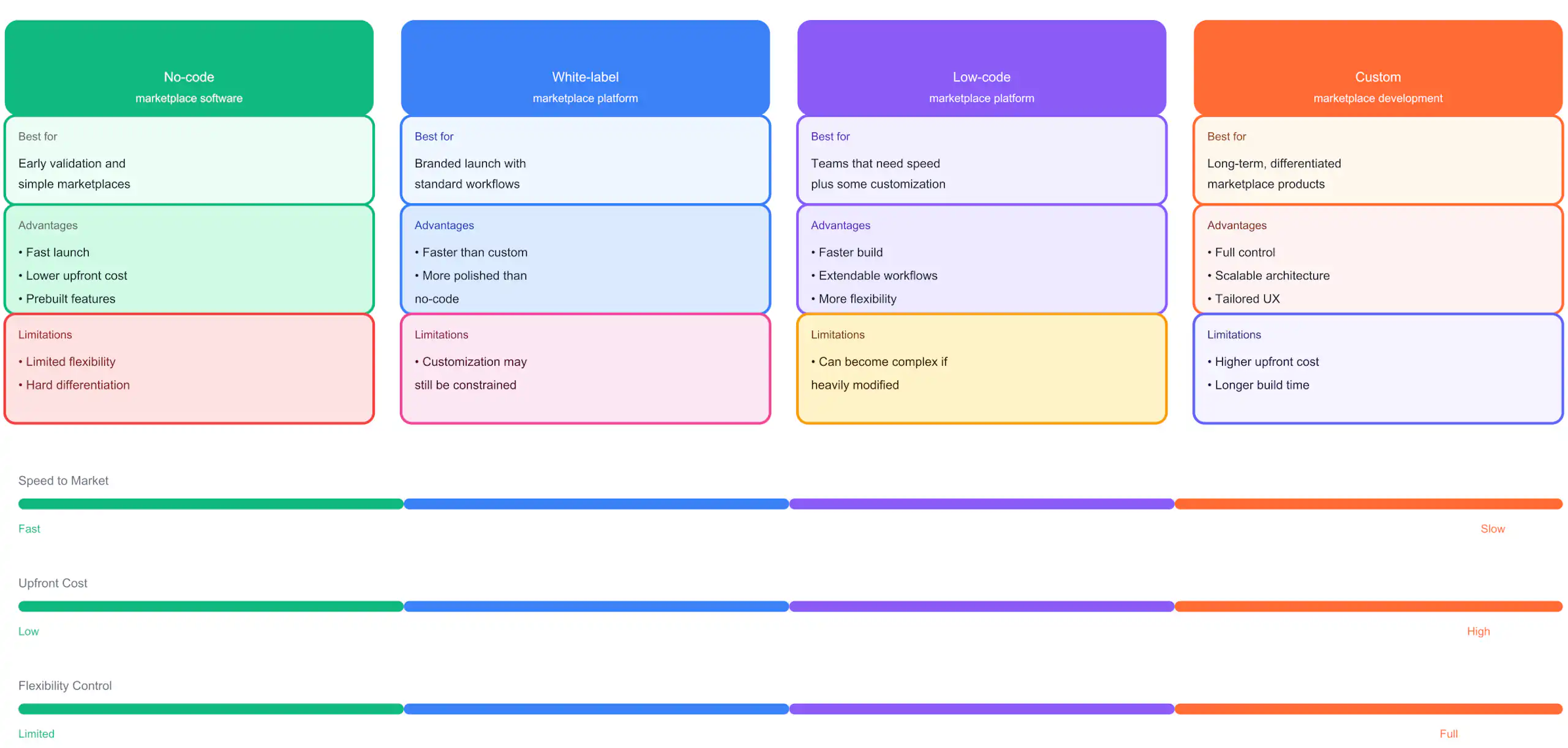
A practical approach is to decide based on risk. If your biggest risk is demand, start lean. If your biggest risk is execution, trust, matching quality, compliance, or scalability, invest in custom marketplace development earlier.
The cost to build a service marketplace depends on scope, complexity, team structure, location, integrations, and the level of product strategy required before development begins.
As a planning guide, most custom service marketplace projects fall into these ranges:
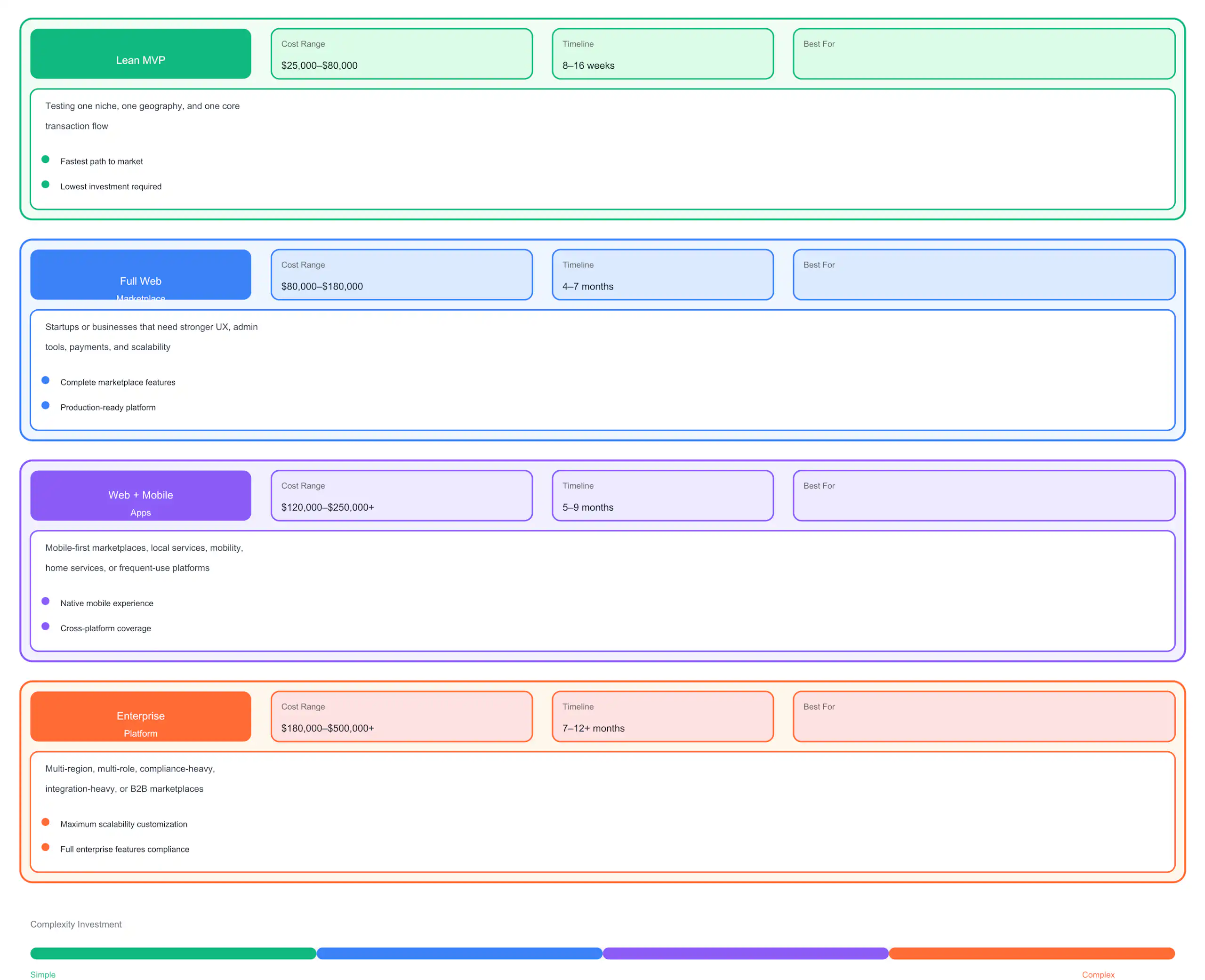
These are not fixed quotes. They are realistic planning ranges. A focused marketplace for booking tutors in one city will cost much less than a nationwide home services marketplace with real-time dispatch, provider verification, mobile apps, complex payouts, and multi-language support.
1. Product strategy and UX design
Before writing code, you need to define the user journeys, marketplace model, provider onboarding flow, revenue model, core features, and MVP scope.
Skipping this stage often leads to expensive rebuilds later.
2. Marketplace complexity
A simple listing and booking platform is cheaper than a marketplace with custom quotes, dynamic pricing, location matching, recurring bookings, subscriptions, multi-provider jobs, or project milestones.
3. Payment flows
Payments can become complex quickly. A marketplace may need deposits, escrow-like holding flows, split payments, refunds, cancellation fees, commissions, provider payouts, tax handling, invoices, wallet balances, or multi-currency support.
Using established payment infrastructure can reduce risk, but the flows still need to be designed correctly.
4. Mobile apps
Native iOS and Android apps increase cost, especially if the marketplace needs location tracking, push notifications, provider availability, route maps, offline mode, or real-time job updates.
For many MVPs, a responsive web app is enough. For local services or high-frequency bookings, mobile apps may be necessary sooner.
5. Provider verification and compliance
Some categories need ID verification, document upload, background checks, professional license, certifications, insurance records, or manual approval.
This adds admin workflows, third-party integrations, data security requirements, and operational complexity.
6. Admin and operations tools
A marketplace is not only a customer-facing product. The internal team needs tools to manage providers, bookings, disputes, refunds, commissions, content, support tickets, suspicious activity, and performance metrics.
A weak admin panel creates manual work that slows down growth.
7. Integrations
Common integrations include payment providers, map services, calendar tools, CRM systems, email platforms, SMS providers, analytics tools, accounting software, identity verification services, and customer support platforms.
8. Security and scalability
Marketplaces handle personal data, financial transactions, messages, reviews, and sometimes sensitive documents. Security, access control, audit logs, backups, monitoring, and performance planning should be part of the build from the beginning.
The smartest way to reduce cost is not to cut corners. It is to reduce scope.
Start with one customer segment, one provider segment, one geography, one service category, and one clear transaction flow.
For example, instead of building “a marketplace for all home services,” start with “a marketplace for vetted cleaning and handyman services in London.” Once you prove supply, demand, conversion, and repeat bookings, you can add more categories.
Most service marketplaces use one or more of these revenue models.
The marketplace takes a percentage of each completed booking. This is one of the most common models because the platform earns when providers earn.
Commission rates vary by category, service value, customer acquisition cost, and platform involvement. Upwork, for example, says freelancer service fees range from 0% to 15% per contract, while Airbnb applies different service fee structures across stays, services, and experiences.
Providers pay to receive customer leads or quote requests. This model is common in home services, legal services, insurance, and B2B services where one successful job can justify the lead cost.
The risk is provider frustration if lead quality is low. Strong lead filtering and transparent pricing are important.
Providers pay a monthly or annual fee to access the platform, receive visibility, use tools, or manage bookings. This can work well when providers receive consistent value even before each transaction.
Providers pay to list services, post premium listings, or publish in certain categories.
This is easier to implement but can discourage providers if the marketplace does not already have enough customer demand.
Providers pay for higher visibility in search results, category pages, local pages, or recommendation sections.
This should be handled carefully. If paid placement reduces result quality, customer trust can suffer.
Some B2B marketplaces charge businesses for access to workflow tools, vendor management, procurement features, dashboards, analytics, or private marketplace infrastructure.
Many mature platforms combine commissions, subscriptions, promoted listings, lead fees, and value-added services. The right model depends on your market, user behaviour, and how much value the platform creates during the transaction.
For founders and businesses, this model is attractive because it can turn a fragmented service market into a scalable digital platform. But building one successfully requires more than launching a website. You need the right marketplace model, the right feature set, strong provider onboarding, secure payments, and a product roadmap that balances speed with long-term scalability.
Building a service marketplace is not just a development project. It is a product, operations, and growth challenge. The software must support a healthy marketplace dynamic where customers find value, providers earn reliably, and the platform can scale without losing trust.
1. Choose a focused marketplace niche
Start narrow. Broad marketplaces are harder to launch because you need enough customers and providers across many categories at once.
A focused niche helps you understand user needs, build targeted features, recruit providers faster, and create stronger SEO pages.
Examples of focused marketplace ideas include:
The best niche has a painful problem, frequent demand, fragmented supply, and enough transaction value to support your revenue model.
2. Validate both sides of the marketplace
A marketplace fails when one side shows up and the other side does not.
Before building a full platform, validate both sides:
You can validate with landing pages, interviews, manual matching, concierge MVPs, spreadsheets, paid ads, provider outreach, and small pilot programes before investing heavily in development.
3. Define the marketplace model
Decide how the transaction will work.
These decisions shape your database, user journeys, admin panel, payment architecture, and growth strategy.
4. Map the customer and provider journeys
A good marketplace experience feels simple because the complexity is handled behind the scenes.
For customers, map the journey from search to booking, payment, service delivery, review, and repeat booking.
For providers, map the journey from sign-up to approval, profile setup, service listing, receiving requests, accepting work, communicating, completing jobs, and receiving payouts.
For admins, map how the internal team will approve providers, manage disputes, issue refunds, edit content, monitor fraud, handle support, and track marketplace health.
5. Build a focused MVP
Your MVP should include only the features needed to complete the core transaction safely.
For many service marketplaces, an MVP includes:
This is enough to test whether users can find, book, pay, and review successfully.
6. Design trust into the product
Trust is the difference between a listing website and a marketplace people will actually use.
Trust features may include verified profiles, reviews, ratings, identity checks, badges, response-time indicators, refund policies, transparent pricing, customer support, secure payments, cancellation rules, and provider quality standards.
In home services, healthcare, finance, childcare, and B2B categories, trust is even more important because the perceived risk is higher.
7. Plan payments and compliance early
Do not leave payments until the end of the project.
The payment flow affects onboarding, checkout, provider payouts, refunds, taxes, receipts, financial reporting, and compliance. It also affects user trust.
Decide early whether you need:
A software partner should help you choose the right payment architecture before development begins.
8. Launch in one market first
A marketplace needs liquidity. Liquidity means customers can find enough relevant providers, and providers can receive enough valuable demand.
If you launch across too many categories or locations too early, you spread supply and demand too thin.
A better approach is to dominate one category, location, or customer segment first. Once that market works, expand into adjacent categories or regions.
9. Measure marketplace health
Do not judge success only by traffic. A marketplace can receive traffic and still fail if users do not transact.
Track metrics such as:
These metrics show whether the marketplace is becoming more useful over time.
10. Improve and scale
After launch, use real data to improve the product.
You may discover that customers need better filters, providers need calendar tools, admins need stronger moderation, or payments need more flexible flows.
Scaling can include mobile apps, advanced matching, referral programes, loyalty features, provider subscriptions, location pages for SEO, automation, integrations, and expansion into new service categories.
Building too broadly from day one
Trying to launch with too many categories, locations, and user types makes the marketplace harder to manage. Start narrow, prove liquidity, then expand.
Copying another marketplace without understanding the model
Uber, Airbnb, Upwork, and Thumbtack work because their product decisions fit their specific market. Your marketplace needs workflows built around your users, pricing, trust requirements, and operating model.
Underestimating provider acquisition
Many founders focus on customer acquisition and forget that providers also need a reason to join, stay active, respond quickly, and deliver quality.
Treating payments as a simple checkout feature
Marketplace payments are more complex than normal ecommerce payments. Payouts, commissions, refunds, cancellations, disputes, tax, and compliance need careful planning.
Launching without enough admin tools
Manual operations are normal in the early stage, but your team still needs a reliable admin panel. Without it, support, refunds, provider approvals, and disputes become difficult to manage.
Ignoring SEO architecture
Many service marketplaces depend on organic search. Category pages, location pages, provider pages, service pages, schema, internal links, and fast performance should be planned from the start.
A service marketplace may be a strong opportunity if the market is fragmented, customers struggle to find trusted providers, providers need better access to demand, and the platform can make the transaction easier, safer, or faster.
It is especially promising when:
However, a marketplace is not the right model for every business. If you only sell your own services, you may need a service booking platform, not a marketplace. If users do not need to compare providers, a directory may be enough. If supply and demand are both difficult to acquire, a marketplace may require a stronger go-to-market strategy before development.
The right software partner should help you make that decision before you spend heavily on development.
A successful service marketplace needs more than clean code. It needs product thinking, scalable architecture, secure payments, intuitive UX, strong admin tools, and a roadmap that supports real business growth.
At Wazobia Technologies, we help businesses design and build custom software products from MVP to enterprise scale. If you are planning a service marketplace, our team can help you clarify the model, define the MVP, design the customer and provider experience, choose the right technology stack, integrate payments, and build a platform that can grow with your business.
Whether you are validating a marketplace idea, replacing off-the-shelf marketplace software, or building a custom platform from scratch, the right development approach can reduce risk and help you launch with confidence.
Need a software development company to build your service marketplace? Schedule a free consultation to plan, design, and develop a marketplace platform built around your business model.
1. What is a service-based marketplace?
A service-based marketplace is a digital platform where customers find, compare, book, and pay service providers such as cleaners, tutors, drivers, consultants, or repair professionals. Instead of selling physical products, it sells access to expertise, time, availability, and trust through profiles, reviews, scheduling, messaging, and secure payments.
2. What is an online service marketplace?
An online service marketplace is a website or app that brings service buyers and providers into one managed transaction flow. Users can search for services, compare prices and ratings, book a provider, communicate, pay online, and leave reviews while the platform earns through commissions, subscriptions, lead fees, or listing fees.
3. What are the key features of a service marketplace?
The key features of a service marketplace include customer and provider profiles, service listings, search and filters, booking or quote requests, messaging, online payments, reviews, ratings, and an admin dashboard. More advanced platforms may also include provider verification, location-based matching, calendars, dispute management, and automated payouts.
4. How much does it cost to build a service marketplace?
It typically costs $25,000–$80,000 to build a focused service marketplace MVP, $80,000–$180,000 for a fuller web and mobile platform, and $180,000+ for complex, multi-region products. Costs depend on matching logic, payments, mobile apps, verification, integrations, admin tools, security, and compliance needs.
5. What's the difference between building one and using marketplace software?
Building a service marketplace gives you custom workflows, stronger differentiation, and long-term control over user experience, data, and revenue model. Marketplace software or white-label platforms launch faster with prebuilt features, but they can limit customization, integration flexibility, scalability, and ownership as your business model becomes more specific.
6. What is the best way to start a service marketplace?
The best way to start a service marketplace is to begin with one clear niche, one target customer group, one provider group, and one location or service category. This makes it easier to test demand, attract providers, manage quality, and improve the platform before expanding into more categories or regions.
A service marketplace connects customers with providers and makes the process of finding, booking, paying, and reviewing services easier. The best platforms do more than list providers. They create trust, manage transactions, improve discovery, support communication, and help both sides complete the job successfully.
If you are building a service marketplace, start with a focused niche, validate demand, define the transaction model, build only the essential MVP features, and plan payments, trust, and operations from the beginning.
Off-the-shelf service marketplace software can be useful for quick validation, but custom marketplace development gives you more control when your workflows, revenue model, integrations, or user experience need to be differentiated.
The strongest marketplace products are built with both the business model and the software architecture in mind.
Keep Reading
Jul 23, 2026 · 8 min read
Compare a database vs spreadsheet for managing business data. Learn the signs that spreadsheets are limiting your workflow and what to use instead.

Jul 23, 2026 · 9 min read
Compare SQL vs NoSQL databases by structure, transactions, scalability and use case. Learn which architecture is right for your application.
.jpg_7DAeB8?tr=w-2560,f-webp,q-50)
Jul 23, 2026 · 8 min read
Find the best database for web applications based on SaaS, ecommerce, marketplace, real-time and content use cases. Compare the practical trade-offs.
© Wazobia Technologies 2026
