
Jul 05, 2026 · 7 min read
Acceptance Criteria vs Definition of Done: What Teams Need to Know
Learn acceptance criteria vs definition of done, how they differ from requirements, and when software teams should use each one.
Services
Our service offers a team of engineers, designers, and QA specialists to achieve your goals.
See how it worksYou gain a team of experts including engineers, designers, and QA who drive your project.
See what our Dev team can build for you
Acceptance criteria are the specific, testable conditions a feature, user story, or product requirement must meet before it is accepted as complete. They clarify expected behaviour, edge cases, limits, and success measures so product owners, developers, QA teams, and stakeholders can agree when the work is done.
For startups, product teams, and professional services firms, acceptance criteria reduce guesswork. They help teams avoid scope creep, missed expectations, unclear handovers, and expensive rework during software development.
When acceptance criteria are written well, everyone knows what should be built, what should be tested, and what must happen before a feature is approved.
In this guide, we’ll cover what acceptance criteria mean, why they matter, where they fit in Agile and the software development lifecycle, the common formats, practical examples, user story usage, and how acceptance criteria differ from requirements and the definition of done.
Acceptance criteria are the conditions a product, feature, or user story must satisfy before it can be accepted by the product owner, client, or end user.
They turn broad requirements into clear outcomes. Instead of saying “users should be able to log in,” acceptance criteria define what a successful login should include, what happens when the password is wrong, what error message should appear, and what security rules must apply.
A simple acceptance criteria example could be:
User story: As a customer, I want to reset my password so I can regain access to my account.
Acceptance criteria:
This gives the development and QA team a clear way to confirm whether the feature works as expected.
Acceptance criteria matter because software projects often fail when expectations are assumed rather than clearly defined.
A founder may expect one workflow. A developer may build another. A tester may validate only the happy path. A client may reject the final feature because a key edge case was never discussed. Acceptance criteria reduce these risks before the work starts.
They help software teams:
For business-critical systems, this is especially important. If you are building a customer portal, internal workflow tool, SaaS platform, or automation system, unclear acceptance criteria can lead to delays, defects, and avoidable cost.
Acceptance criteria are commonly used in Agile teams, especially when writing user stories for product backlogs. In Agile, they usually sit inside each backlog item or user story and describe what must be true before that story can be accepted.
In Scrum, acceptance criteria are often discussed during backlog refinement, sprint planning, development, testing, and sprint review. The product owner may start the criteria, but the best results come when developers, QA testers, designers, business analysts, and stakeholders review them together.
Acceptance criteria also fit into the wider software development lifecycle. During discovery, they help turn business goals into clear requirements. During design, they shape workflows and user experience decisions. During development, they guide implementation. During QA, they become the basis for test cases. During user acceptance testing, they help stakeholders confirm whether the delivered software solves the original problem.
This is why acceptance criteria should not be treated as a minor project management note. They are a practical bridge between business requirements, technical delivery, and quality assurance. For deeper planning work, they also connect closely with user requirements specification, especially when the project needs clearer documentation before development begins.
Acceptance criteria are easier to understand when you see them in real product situations. They can be written for login forms, dashboards, payment flows, onboarding journeys, API integrations, admin panels, search features, reporting tools, and non-functional requirements like security or performance.
For example, a payment feature might include criteria for successful payment, failed payment, duplicate payment prevention, receipt generation, and payment status updates. A dashboard feature might include criteria for data filters, loading states, permissions, empty states, and export options.
The key is to make each condition specific enough to test. “The dashboard should be fast” is too vague. “The dashboard should load the first 50 records within 3 seconds on a standard connection” is clearer and easier to verify.
For a larger library of worked examples across user stories, forms, APIs, features, and non-functional requirements, read our full guide on acceptance criteria examples.
Acceptance criteria are usually written in two common formats: scenario-based and rule-based.
The scenario-based format is often written as Given/When/Then, also known as Gherkin syntax. It works well when you need to describe a user action and system response.
Example:
Given the user is on the login page
When the user enters a valid email and password
Then the system logs the user in and redirects them to the dashboard
This format is useful for user journeys, conditional logic, test automation, and workflows where a clear action leads to a clear result.
The rule-based format is written as a checklist. It works well when the feature has simple conditions, business rules, validations, or requirements that do not need a full scenario.
Example:
Both formats are valid. The right choice depends on the feature. Use Given/When/Then when behaviour depends on context and user action. Use checklist format when you need simple, direct conditions. For templates, examples, and format guidance, see our full guide to acceptance criteria formats.

Acceptance criteria and user stories work together, but they are not the same thing.
A user story describes the user’s goal. Acceptance criteria define the conditions that prove the story has been delivered correctly.
A common user story format is:
As a [user], I want [goal], so that [benefit].
Example:
As a project manager, I want to filter tasks by status, so that I can quickly see what is pending, in progress, or completed.
Acceptance criteria for that story could include:
This level of detail helps developers understand the expected behaviour and helps QA teams test the story properly. It also helps product owners decide whether the story is ready to move from backlog to sprint.
For a deeper breakdown of how acceptance criteria work inside user stories, including story-level examples, read our guide on acceptance criteria for user stories.
Good acceptance criteria should be clear, testable, realistic, and linked to the user or business outcome.
A practical writing process looks like this:
A good acceptance criterion should pass a simple test: can someone verify it as true or false? If not, it is probably too vague.
For example, “the system should be secure” is not strong acceptance criteria. A clearer version would be: “The system must lock the account for 15 minutes after five failed login attempts.”
A good acceptance criteria checklist should confirm that each item is specific, testable, user-focused, technically realistic, and aligned with the expected business outcome. For a full step-by-step process, writing checklist, and common mistakes to avoid, read our guide on how to write acceptance criteria.
Acceptance criteria, requirements, and definition of done are closely related, but they serve different purposes.
Requirements describe what the product or system needs to do. They can be broad and may cover business needs, functional requirements, non-functional requirements, compliance needs, integrations, and user expectations.
Acceptance criteria define the specific conditions that prove a feature or user story meets the requirement.
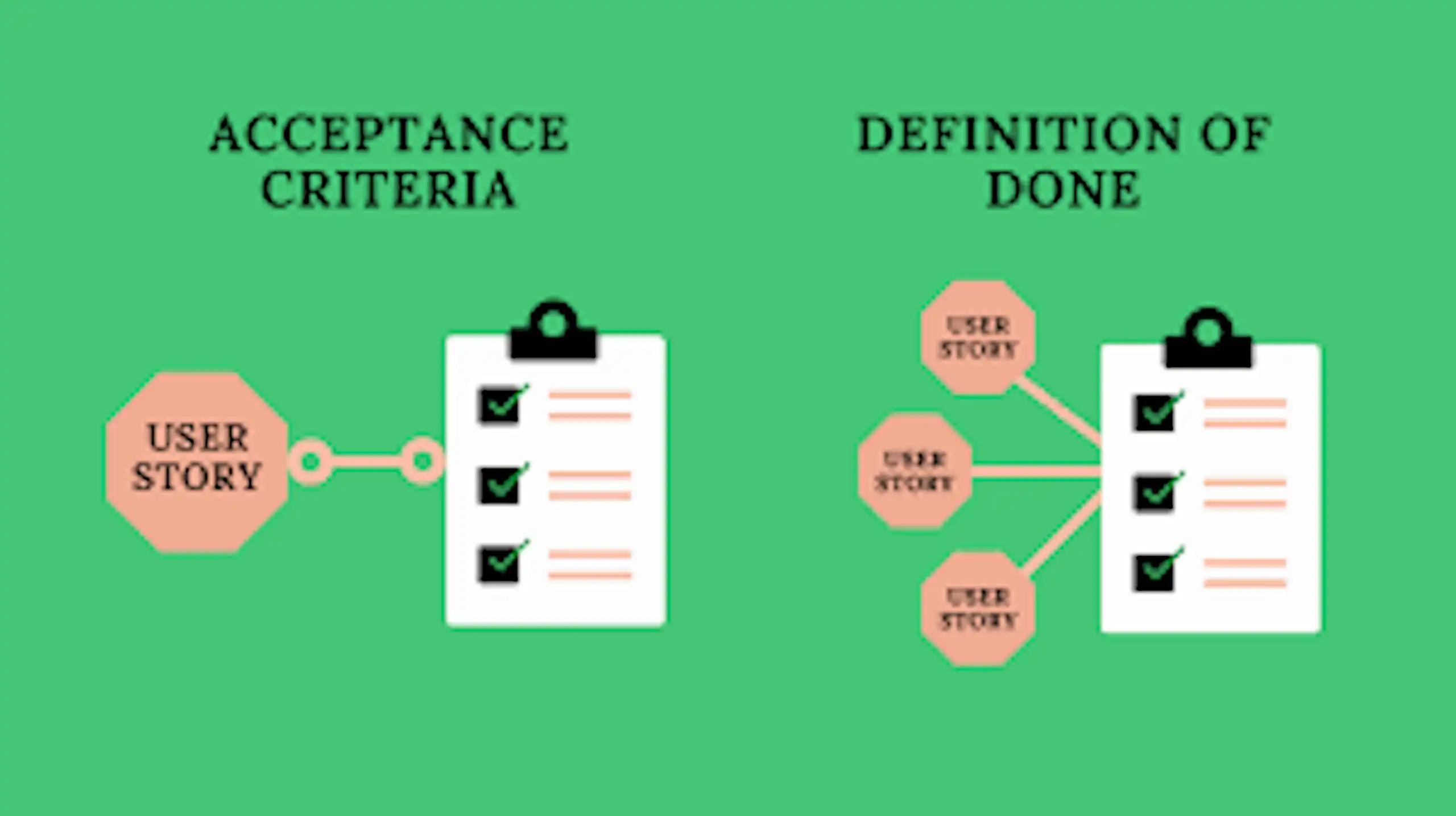
Definition of done is a team-level standard for when any work item can be considered complete. It may include code review, testing, documentation, accessibility checks, deployment readiness, and internal quality standards.
Here is a simple way to understand the difference:

Acceptance criteria are specific to a feature or user story. Definition of done usually applies across the team or project. Requirements often sit earlier in the planning process and may need to be broken down before development begins.
This distinction matters because confusing them can create delivery gaps. A team may meet its definition of done but still fail a feature’s acceptance criteria. A requirement may be approved, but without clear acceptance criteria, the team may still build the wrong thing. For a deeper comparison, read our guide on acceptance criteria vs definition of done.
Acceptance criteria are often written by the product owner, business analyst, product manager, or project lead. However, they should not be written in isolation.
The strongest acceptance criteria usually come from collaboration between:
This collaboration helps identify missing scenarios before development starts. It also makes the criteria more realistic, testable, and useful during delivery.
Acceptance criteria should be written before development begins. In Agile teams, this often happens during backlog refinement or sprint planning.
A user story should not enter a sprint if the team does not understand what success looks like. Unclear acceptance criteria can lead to estimation problems, blocked developers, weak testing, and disagreements during review.
That said, acceptance criteria can be updated when new information appears. The goal is not to freeze every detail too early. The goal is to make sure the team has enough clarity to build and test the right thing.
Good acceptance criteria are simple, specific, and testable.
They should describe what the user or system must be able to do, not how the developer should implement it. They should be clear enough for non-technical stakeholders to understand, but detailed enough for developers and testers to use.
Strong acceptance criteria usually include:
Weak acceptance criteria often include vague words, missing edge cases, unclear ownership, or technical instructions that limit implementation too early.
One common mistake is writing acceptance criteria that are too broad. “The user can manage invoices” is not enough. Invoice creation, editing, deletion, permissions, validation, tax calculation, and export behaviour may all need separate criteria.
Another mistake is confusing acceptance criteria with tasks. “Build the invoice page” is a task. “The user can create an invoice with customer name, due date, item description, quantity, price, tax, and total amount” is closer to acceptance criteria.
Teams also run into problems when acceptance criteria ignore failure states. A feature is not complete only because the happy path works. Good criteria should consider invalid inputs, missing data, access restrictions, timeouts, duplicate actions, and error messages.
For software teams, the best approach is to keep the language plain, the scope focused, and the outcome testable.
Use these deeper guides to explore each part of the topic:
You may also find these useful if you are planning a software project:
Acceptance criteria help software teams turn ideas, requirements, and user stories into clear, testable outcomes. They reduce confusion, improve collaboration, and give product owners, developers, QA teams, and stakeholders a shared understanding of what “complete” really means.
For startups and professional services firms, this clarity is not just a technical detail. It protects budget, reduces rework, improves product quality, and helps teams ship software that meets real business needs.
If you are planning a new digital product, internal system, SaaS platform, or workflow automation project, Wazobia Technologies can help you turn business requirements into clear product scope, acceptance criteria, and delivery-ready software. Explore our software development partnership or schedule a free consultation to discuss your project.
1. What is acceptance criteria in simple terms?
Acceptance criteria are the conditions a feature or user story must meet before it is accepted as complete. They explain what should happen, what should be tested, and how the team will know the work meets the expected outcome.
2. What is an example of acceptance criteria?
For a password reset feature, acceptance criteria may include: the user can request a reset link, the link is sent to the registered email, the link expires after 30 minutes, and the user sees an error message if the email is not registered.
3. Who writes acceptance criteria?
Acceptance criteria are usually written by the product owner, product manager, business analyst, or project lead. However, developers, QA testers, designers, and stakeholders should review them to make sure they are clear, testable, and realistic.
4. What are the main acceptance criteria formats?
The two main formats are Given/When/Then and checklist format. Given/When/Then is useful for user actions and system responses. Checklist format is useful for simple rules, validations, and conditions.
5. Are acceptance criteria only used in Agile?
No. Acceptance criteria are common in Agile and Scrum, but they are useful in any software development process where teams need clear, testable conditions for approving work.
6. Can acceptance criteria change during development?
Yes, acceptance criteria can change if new information appears. However, changes should be discussed and agreed with the relevant stakeholders so the team stays aligned on scope, timeline, and expected outcome.
Keep Reading
Jul 05, 2026 · 7 min read
Learn acceptance criteria vs definition of done, how they differ from requirements, and when software teams should use each one.

Jul 05, 2026 · 7 min read
Learn how to write acceptance criteria with clear steps, formats, examples, a practical checklist, and common mistakes to avoid.

Jul 05, 2026 · 7 min read
Learn how acceptance criteria work in user stories, with clear examples, writing tips, story splitting guidance, and FAQs.
© Wazobia Technologies 2026
